Here you will fine Aesops Fables translated into Sindarin. Check out my good friend Chaered's site Ungwe.net with Quenya translations.

A List of the Fables


i·Chebyr ah e·Vund

Notes:
1 Reviewed on Vinyë Lambengolmor by Ellanto on 1/24/26.
§
Sindarin
Back Translation
Original
1.1
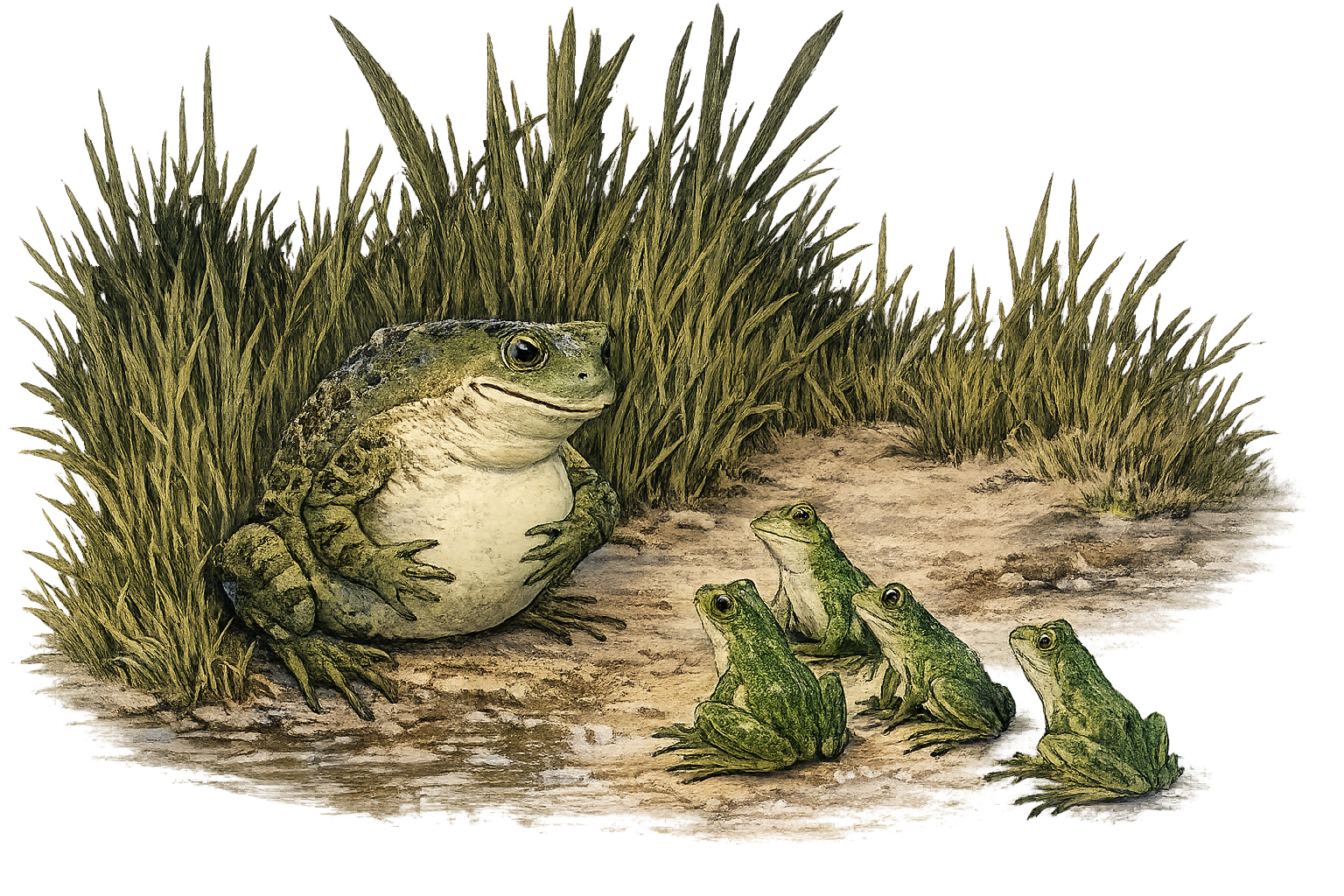
Mund odul n’ ael na lisg an hoged.
[A] Bull came to [a] pool of reeds to drink.
An Ox came down to a reedy pool to drink.
1.2
Lo falaechast vin nen vo dhram, nistast gabor ‘wain n’ e·vadha.
While he splashed into the water by (agent of) [a] heavy blow, he pressed [a] young frog into the mud.
As he splashed heavily into the water, he crushed a young Frog into the mud.
1.3
Rong e·gabor iaur anírant e·gabor bîn a mabent i·Chenair a nethil dín man hídant anden.
Soon the old frog longed for the little frog and asked his brothers and sisters what happened to him.
The old Frog soon missed the little one and asked his brothers and sisters what had become of him.
1.4
“Úan mbelaith,” ebent ben na thin, “Abant bo chanar bîn vo vin i·thail velig dín!”
“[A] mighty monster,” said one of them, “he stepped on little brother with one of his great feet!”
"A great big monster," said one of them, "stepped on little brother with one of his huge feet!"
1.5
“Te vorg!” ebent e·gabor iaur, whestol1 en·ammos dín.
He [was] big! said the old frog, puffing her chest.
"Big, was he!" said the old Frog, puffing herself up.
1.6
“Borg ve hen?”
“Big like this?”
"Was he as big as this?"
1.7
“A! Ammorg!” agóner.
“O!, Bigger!” they shouted.
"Oh, much bigger!" they cried.
1.8
e·Gabor cwhestant1 en·ammos dín am.
The frog puffed her chest more.
The Frog puffed up still more.
1.9
“Ú-obul en·úan nad ammorg athar hen,” ebent.
“He could not be bigger beyond this,” she said.
"He could not have been bigger than this," she said.
1.10
Ach i·chebyr bîn il ebenner i ammorg en·úan ah e·gabor cwhestant1 en·ammos dín am ah am naden aranc.
But the little frogs all said that the monster was bigger and the old frog puffed his chest more and more until she burst.
But the little Frogs all declared that the monster was much, much bigger and the old Frog kept puffing herself out more and more until, all at once, she burst.
Notes:
1 whesta-, v. “to puff” ⪤ ᴹQ. hwesta-, v. “to puff”

Glingad nell oh en·ieath nan e·Vuig

Notes:
1 Not reviewed.
§
Sindarin
Back Translation
Original
1.1
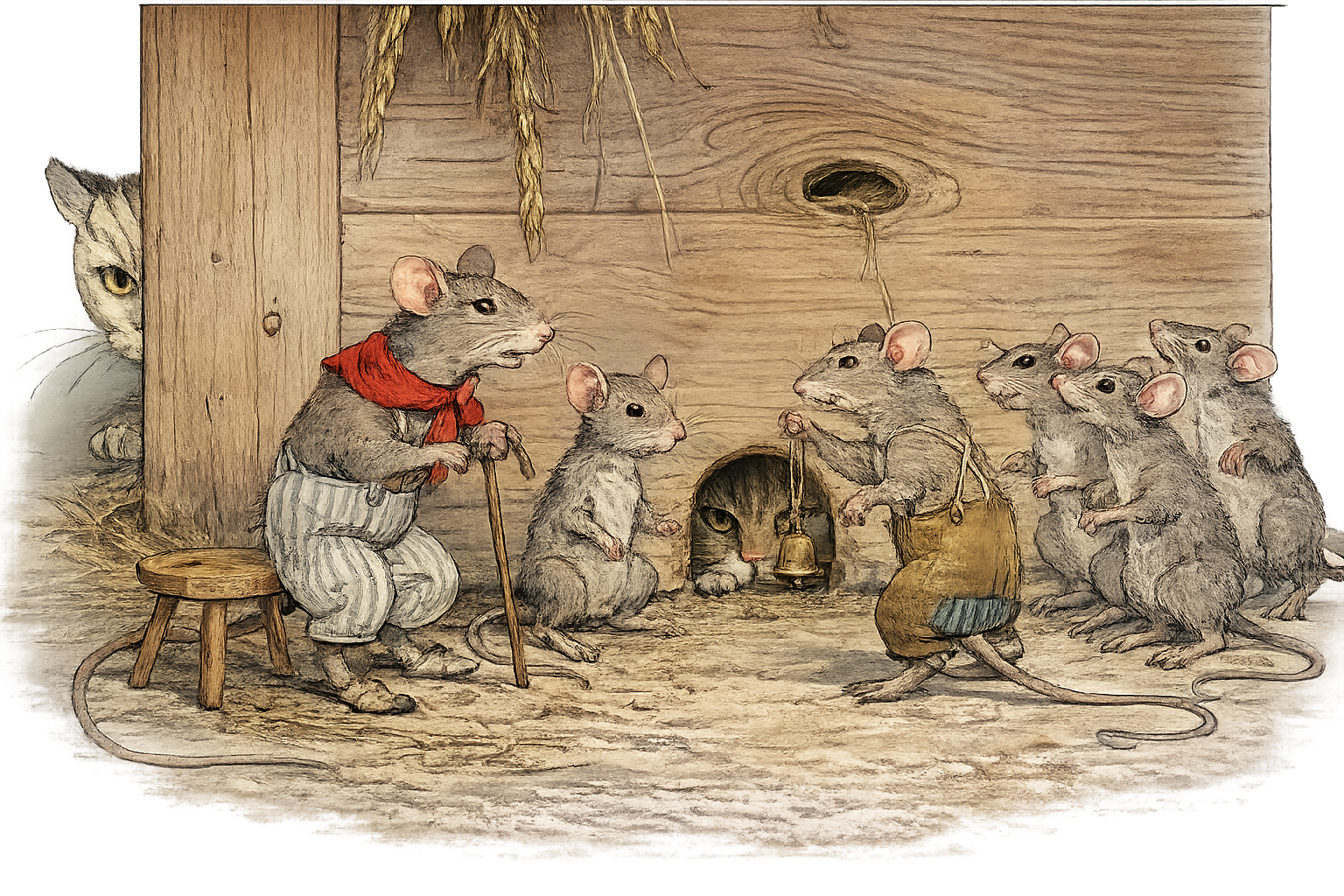
Erlu i·nigyl nachóver chûd amarthad banu al leithiad din ui goth dín, e·Vuig.
Once the mice summoned [a] assembly to decree [a] plan to free them from their enemy, the Cat.
The Mice once called a meeting to decide on a plan to free themselves of their enemy, the Cat.
1.2
An evírer hired leng1 n’ istad i anglennast, to2 êg i havathar nored ‘wa.
For they wished to find a manner of having knowledge that she approached, so [there] is a chance that they have time to run away.
At least they wished to find some way of knowing when she was coming, so they might have time to run away.
1.3
Î, boe andin cared aenad3, an dorthasser vi thoss nan i·phuid dín i ú-verthasser haenad i·chaew dín vin dû egor aur.
Indeed, [it] needs for them to do anything, for they dwelt in fear of her animal feet that they did not dare to leave their dens in the night or day.
Many plans were discussed, but none of them was thought good enough.
1.4
Ethrebennin lae na pheny, ach û vaer ae4 nan i·pheny hain.
Discussed [were a] great number of plans, but not good [were] any of those plans.
"A great big monster," said one of them, "stepped on little brother with one of his huge feet!"
1.5
Na vedui Nigol ‘wain ador ah ebent:
At last [a] young Mouse stood and said:
At last a very young Mouse got up and said:
1.6a
“Sevin benu i nêf athgar, a bedhin pelif crannad den.
“I have [a] plan that seems easy to do, and I judge that we can accomplish it.
"I have a plan that seems very simple, but I know it will be successful.
1.6b
Il mboe ammen cared ‘lingad nell oh en·iaeth nan e·Vuig.
All [it] needs for us to do [is] to hang [a] bell around the neck of the Cat.
All we have to do is to hang a bell about the Cat's neck.
1.6c
Io lhassof e·nellad, istof i e·goth vín tôl.”
When we hear the ringing bell, we will have knowledge that our enemy comes.”
When we hear the bell ringing we will know immediately that our enemy is coming."
1.7
Gaedennin il i·Nigyl i aw û nauth fo5 nan e·benu hain.
Astounded [were] all the Mice that they had no thought before of this plan.
All the Mice were much surprised that they had not thought of such a plan before.
1.8
Ach lo ‘ellasser oh en·alvar dín, Ningol iaur eriast ah ebent:
But while they rejoiced about their good fortune, [an] old Mouse rose and said:
But in the midst of the rejoicing over their good fortune, an old Mouse arose and said:
1.9a
“Pedathon i dhae vaer e·benu nan e·nigol ‘wain.
“I will say that very good [is] the plan of the young mouse.
"I will say that the plan of the young Mouse is very good.
1.9b
Ach dhavo nin mabeded: Man hestatha o glingatha e·nell oh en·iaeth nan e·Vuig?”
But allow me to ask [a] question: Who will hang the bell around the neck of the Cat?”
But let me ask one question: Who will bell the Cat?"
Notes:
1 leng, n. “way, method, manner” ⪤ Q. ¹, n. “way, method, manner” [author: Rínor]
2 to, adv. “so, then” ⪤ Q. , adv. “then, [ᴹQ.] at that time [past]” [author: Elaran]
3 aenad, pron. anything” from ✶ai adv. “supposing” + N. nad, n. “thing” [author: Rínor]
4 ae, adv. “supposing, suppose, maybe; *any” ⪤ Q.ai², adv. “supposing, suppose, maybe; *any”
5 fo, prep. “before” (temporal only) ✶PʰĀ [author: Ellanto]

Nigol ui Garas ah Nigol ui Rídhas

Notes:
1 Not reviewed.
§
Sindarin
Back Translation
Original
1.1
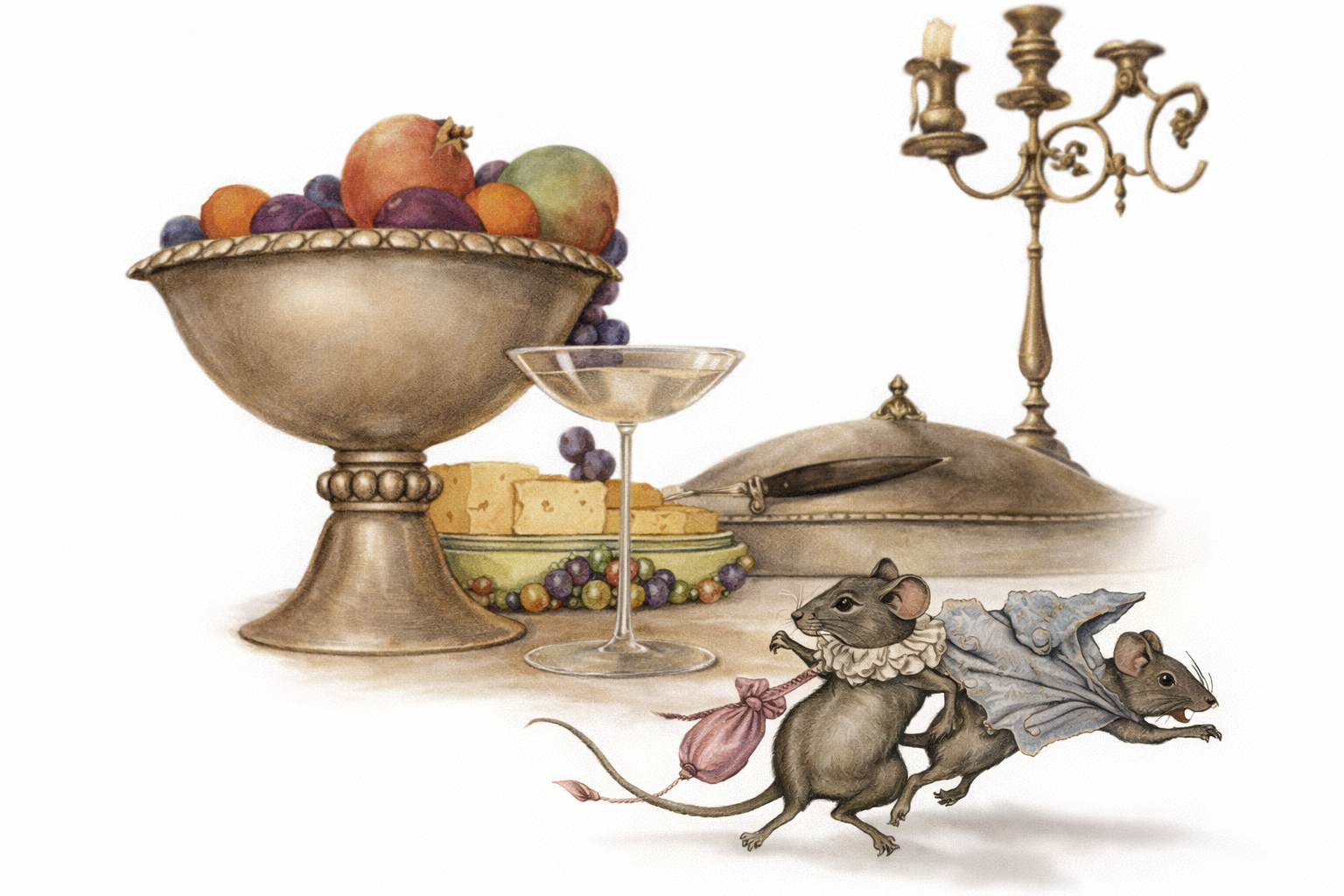
Nigol ui Garas ‘lennast cened ress i ndorthast vidh rídhas.
[A] Mouse from the City traveled to see [a] relative who lived in the country.
A Town Mouse once visited a relative who lived in the country.
1.2
An nedhwad e·Nigol ui Rídhas sestant thrimp na na mbloss, sylch, nych, gu limig na nen ring an hoged cho1 den.
For lunch the Mouse from the Country set stalks of wheat, roots, and acorns, together with [a] small drop of cold water for drink before her.
For lunch the Country Mouse served wheat stalks, roots, and acorns, with a dash of cold water for drink.
1.3
e·Nigol ui Garas avant vo nenc dithin, nadhol tithen na sen a thithen na san, a moe leng dín tanant i avant vath thonnui air nad runnas2.
The Mouse from the City ate by (agent of) tiny bites, chewing [a] little of this and [a] little of that, and by (agent of) her manner indicated that she ate the basic food only to be polite.
The Town Mouse ate very sparingly, nibbling a little of this and a little of that, and by her manner making it very plain that she ate the simple food only to be polite.
1.4
Ab e·vâd i·mellyn ebenner an annas na lû, egos sennui e·Nigol ui Garas ebent oh e·guil dín viñ garas lo e·Nigol ui Rídhas lastast.
After the meal the friends spoke for [a] length of time, or rather the Mouse from the City spoke about her life in the city while the Mouse from the Country listened.
After the meal the friends had a long talk, or rather the Town Mouse talked about her life in the city while the Country Mouse listened.
1.5
To3 gaedast lored aedh laug viñ geilir4 ah olúrer vi dhîn a lhaugas5 naden amor.
Then they lay down to sleep in [a] cozy nest in the hedgerow and slept in silence and warmth until morning.
They then went to bed in a cozy nest in the hedgerow and slept in quiet and comfort until morning.
1.6
Lo lorol e·Nigol ui Rídhas olthant de Nigol ui Garas i aw il e·vaeras a mavras na ndorthad viñ garas i e·vellon dín ebent anden.
While sleeping the Mouse from the Country dreamed she [was a] Mouse from the City who had all the goodness and desires of living in a city that her friend said to her.
In her sleep the Country Mouse dreamed she was a Town Mouse with all the luxuries and delights of city life that her friend had described for her.
1.7
Ach en·aur abor io e·Nigol ui Garas mabent e·Nigol ui Rídhas glannad n’ e·mbâr dín viñ garas, te ‘lass paded naw.
But the following day when the Mouse from the City asked the Mouse from the Country to travel to her home in the city, she [was] happy to say yes.
So the next day when the Town Mouse asked the Country Mouse to go home with her to the city, she gladly said yes.
1.8
Io odúler n’ e·mbarthan ias6 e·Nigol ui Garas dorthast, egíner boe hardh vin ham am maded lemmath7 na mbereth elvain.
When they came to the mansion where the Mouse from the City dwelled, they saw on the table in the chamber for eating [were] leavings of a marvelous feast.
When they reached the mansion in which the Town Mouse lived, they found on the table in the dining room the leavings of a very fine banquet.
1.9
Ho din vaith laich, phibingim8, besgyrn laich, chuir gaudol, î, maith rothagol i Nigol obul nauthad.
Before them [were] sweet foods and jams, sweet loaves sweet, and tasteful cheeses, indeed, the most luring foods could conceive.
There were sweetmeats and jellies, pastries, delicious cheeses, indeed, the most tempting foods that a Mouse can imagine.
1.10
Ach io e·Nigol ui Rídhas fair maded níth9 na mbesgyrn laich, lhassant vuiad vrui na muig a rhibad n’ e·fend.
But when the Mouse from the Country [was] ready to eat [a] small piece of sweet loaf, she heard [a] loud meowing of [a] cat and scratching at the door.
But just as the Country Mouse was about to nibble a dainty bit of pastry, she heard a Cat mew loudly and scratch at the door.
1.11
Mi ‘oe i·Nigyl onúrer na had na thoblad, ias6 eríther úvenol an annas na lû, thossui thuiad.
In great fear the Mice ran to a place of hiding, where they remained unmoving for [a] length of time, fearful to breath.
In great fear the Mice scurried to a hiding place, where they lay quite still for a long time, hardly daring to breathe.
1.12
Io na vedui verthast dammened n’ e·vereth, e·fend lediast vo rongas10 a bŷr minnasser vi am buidad e·hardh, lo e·Hû aphant.
When at last they dared to go back to the feast, the door opened by (agent of) haste and the servants entered to clean the table, while the Dog followed.
When at last they ventured back to the feast, the door opened suddenly and in came the servants to clear the table, followed by the House Dog.
1.13
e·Nigol ui Rídhasas air bediast11 geded e·bôg a rhostobas12 dín viñ gaew nan e·Nigol.
The Mouse of the Country only paused to get her bag and umbrella in the lair of the Mouse.
The Country Mouse stopped in the Town Mouse's den only long enough to pick up her carpet bag and umbrella.
1.14
“No den i hevig vaeras a math elvain i ú-hevin,” ebent lo rongast gwa, “ach vevin e·vath thonnui nín a chuithas thonnui midh Rídhas vi hîdh a beriad i dôl ‘u den.”
“Be it that you have goodness and marvelous food that I do not have,” she said while she hastened away, “but I like my basic food and basic life in the country in peace and protection that comes together with it.”
You may have luxuries and dainties that I have not," she said as she hurried away, "but I prefer my plain food and simple life in the country with the peace and security that go with it."
Notes:
1 ho, prep. “before, in front” (spatial only) ✶KʰĀ [author: Ellanto]
2 runnas, n. “polite, politeness” from ᴺQ. !rundië n. “smoothness; politeness”
3 to, adv. “so, then” ⪤ Q. , adv. “then, [ᴹQ.] at that time [past]” [author: Elaran]
4 ceilir, n. “hedgerow” from S. cai n. “hedge” + S. #lîr n. “line, [N.] row”
5 laugas, n. “warmth” from ᴺS. [N.] ^laug adj. “warm” + S., N. #-as suf. “abstract noun”
6 ias, conj. “where (relative)” ⪤ Q. yassë, conj. “where [relative], in which place” [author: Unknown]
7 lemmath, n. “left over food, leavings” from ᴹ✶ lebnā “left behind” + ᴺS. [ᴱN.] math n. “food”
8 pibingim, n. “jam, (lit.) berry-sticky-substance” ⪤ ᴺQ. !piohimma, n. “jam, (lit.) berry-sticky-substance”
9 níth n. “piece, bit (of indeterminate size)” ⪤ ᴺQ. !nihta n. “piece, bit, small part”
10 rongas, n. “haste” derived from ᴺS. !ronga- ᴺS. v. “to hasten” + S. #-as, suf. “abstract noun” [author: Rínor]
11 pedia- v. to stop, halt, pause – derived from √PUTyă alternative to ᴺS. !posta-, v. “to stop, cease, leave off”
12 rostobas n. “umbrella (lit.) rain roofing” S. ross¹, n. “rain; spray, ⚠️spindrift, foam” + N. tobas “roofing, roof”

e·Rusc ah i·Mirybin

Notes:
1 Not reviewed.
§
Sindarin
Back Translation
Original
1.1
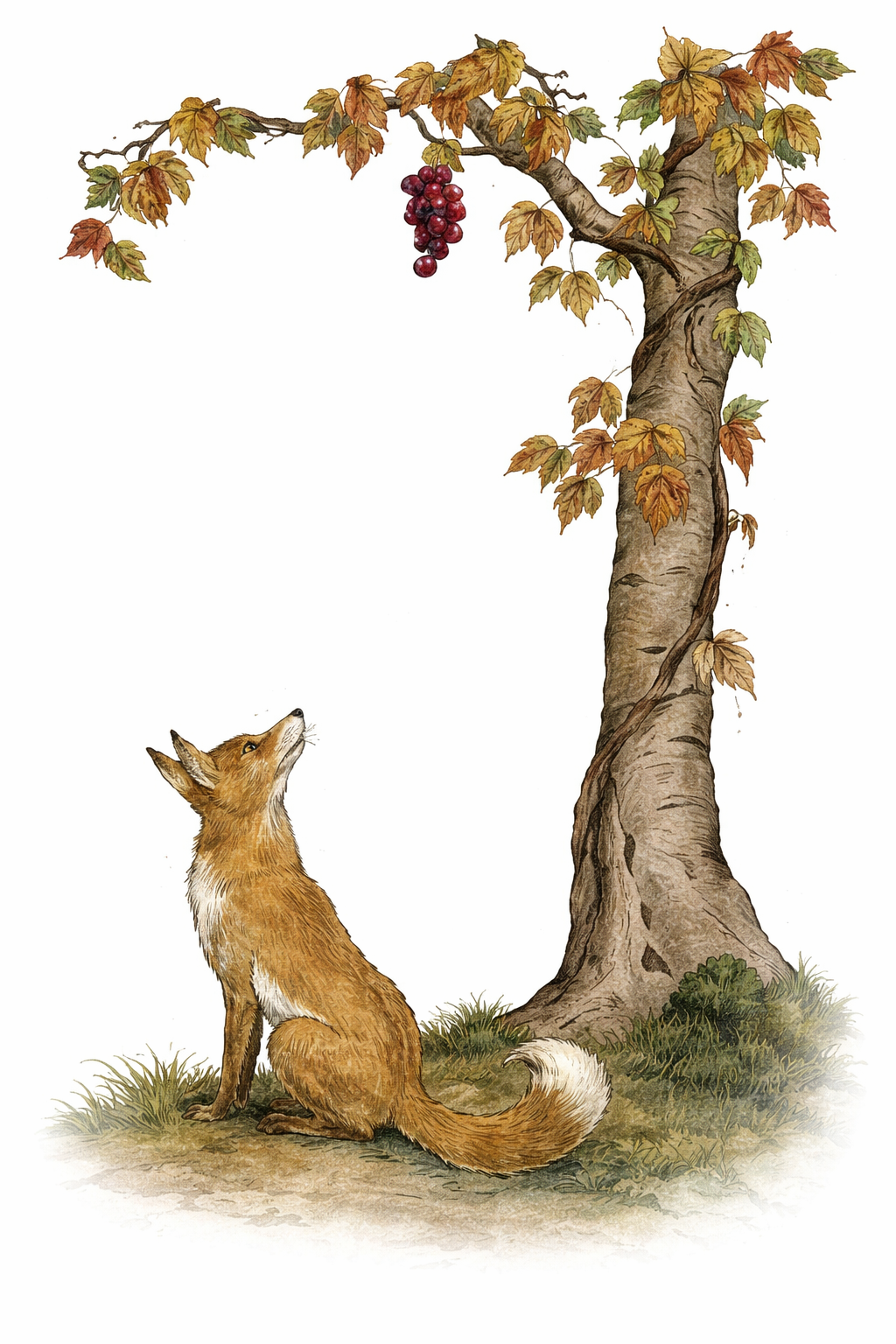
Er aur rusc dírant ban bain na mirybin gîw ‘lingol od longalas1 bela golf galadh.
One day [a] fox saw [a] beautiful arrangement of fresh grapes hanging from a vine along [the] branches of [a] tree.
A Fox one day spied a beautiful bunch of ripe grapes hanging from a vine trained along the branches of a tree.
1.2
i·Mirybin eníver ve ragathar aen vo haw, a gobem e·rusc greithast2 lo edir ah anírant din.
The grapes seemed like they would burst with juice, and [the] mouth [of] the fox drooled while he looked and desired them.
The grapes seemed ready to burst with juice, and the Fox's mouth watered as he gazed longingly at them.
1.3
i·Mirybin ‘lingast o golf vrand, ah e·rusc baurast gabed adh raethad din.
The grapes hung from [a] high branch, and the fox needed to jump to reach them.
The bunch hung from a high branch, and the Fox had to jump for it.
1.4
e·Lû vinui agamp ah edhiw den vo lae.
The first time he jumped and he missed it by (agent of) [a] great number.
The first time he jumped he missed it by a long way.
1.5
To3 gbedrast gwa chaeras4 thent ah agor cabed norol na den, air dhewed lû dadui.
So he walked away [a] short distance and made [a] running leap towards it, only to miss [a] second time.
So he walked off a short distance and took a running leap at it, only to fall short once more.
1.6
Ad ah ad rithast, ach edhiw.
Again and again he tried, but he failed.
Again and again he tried, but in vain.
1.7
Si achodh ah edir i·mirybin vin dêl.
Now he sat and looked towards the grapes in disgust.
Now he sat down and looked at the grapes in disgust.
1.8
“Ni fôf,” ebent.
“I [am a] fool,” he said.
"What a fool I am," he said.
1.9
“Si dhrauthast im gared ban na mirybin oer i û veru nan e·vavras nín.”
“Here I tire myself to get [a] arrangement of nasty grapes that [are] not worthy of my desire.”
"Here I am wearing myself out to get a bunch of sour grapes that are not worth gaping for."
1.10
A phedrast iaewen gwa.
And he scornfully walked away.
And off he walked very, very scornfully.
Notes:
1 longalas, n. “vine (lit.) “curl-plant” derived from ᴺS. [G.] lonc n. “curl” + N. galas n. “plant, growth” [author: Rínor]
2 creitha-, v. “to cause spit, saliva; drool” from ᴺS. [ᴱN., G.] crech n. “spittle”
3 to, adv. “so, then” ⪤ Q. , adv. “then, [ᴹQ.] at that time [past]” [author: Elaran]
4 haeras, n. “distance, (lit.) farness” ⪤ ᴺQ. !hairië n. “distance, (lit.) farness”

e·Dhraug ah e·Nimlang1

§
Sindarin
Back Translation
Original
1.1
Lo vadol, Draug vilf othlonc asg i adamp e·lang.
While eating, [a] greedy wolf swallowed [a] bone that blocked his throat.
A Wolf had been feasting too greedily, and a bone had stuck crosswise in his throat.
1.2
Ú-obul cared en·asg mened am egor dad, ah î ú-obul maded nad.
He could not make the bone go up or down, and indeed he could not eat [a] thing.
He could get it neither up nor down, and of course he could not eat a thing.
1.3
Î he leng2 na nast ‘aer an Draug velch.
Indeed this was [an] awful manner of being for [a] greedy Wolf.
Naturally that was an awful state of affairs for a greedy Wolf.
1.4
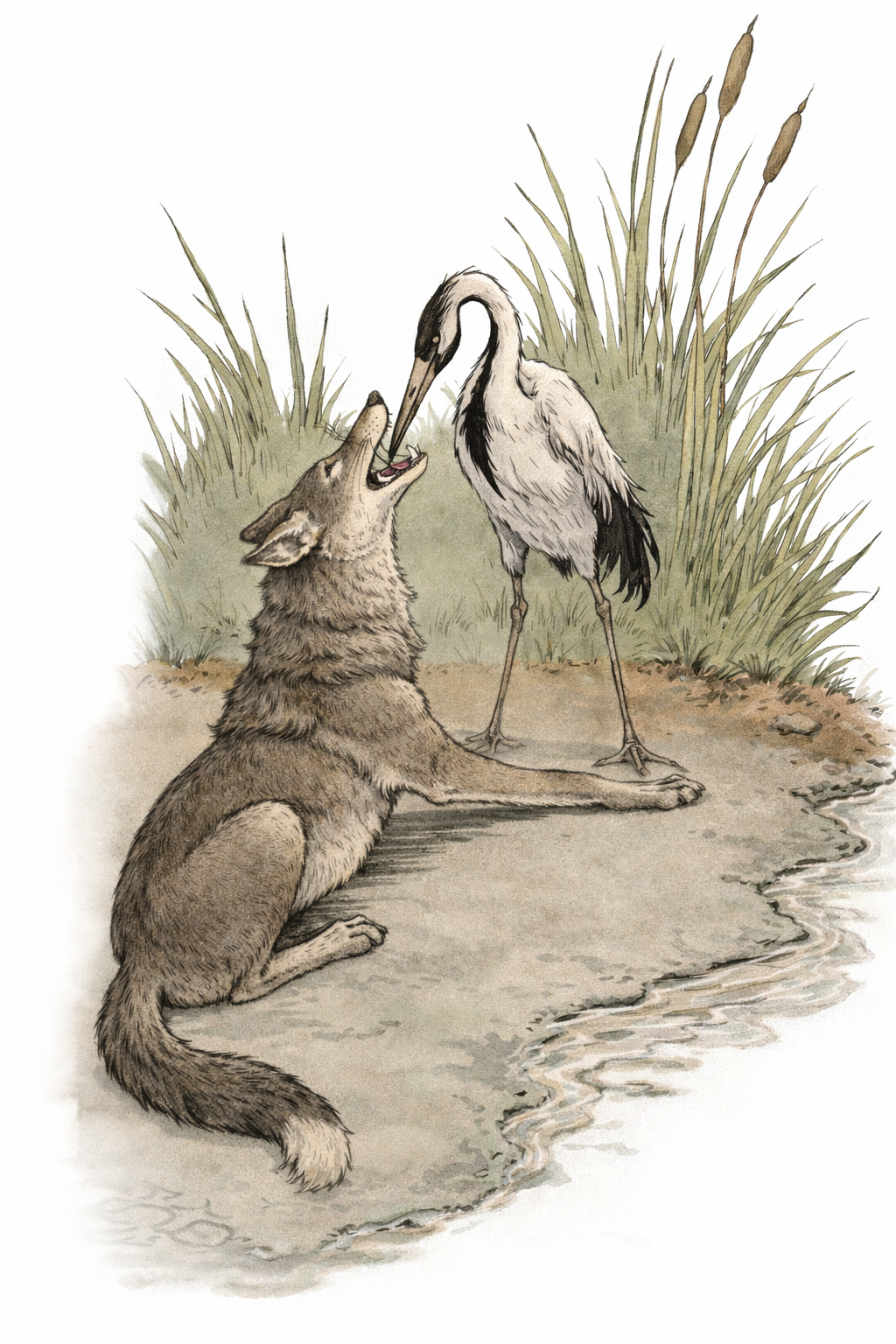
To3 rongast gwa n’ e·Nimlang.
So he hastened away to the Crane.
So away he hurried to the Crane.
1.5
He was sure that she, with her long neck and bill, would easily be able to reach the bone and pull it out.
1.6
"I will reward you very handsomely," said the Wolf, "if you pull that bone out for me."
1.7
The Crane, as you can imagine, was very uneasy about putting her head in a Wolf's throat.
1.8
But she was grasping in nature, so she did what the Wolf asked her to do.
1.9
When the Wolf felt that the bone was gone, he started to walk away.
1.10
"But what about my reward!" called the Crane anxiously.
1.11
"What!" snarled the Wolf, whirling around.
1.12
"Haven't you got it?
1.13
Isn't it enough that I let you take your head out of my mouth without snapping it off?"
Notes:
1 nimlang, n. “crane (lit.) “white-neck” derived from S. nim adj. “white” + S. lang n. “passage; neck, *throat” [author: Rínor]
2 leng, n. “way, method, manner” ⪤ Q. ¹, n. “way, method, manner” [author: Rínor]
3 to, adv. “so, then” ⪤ Q. , adv. “then, [ᴹQ.] at that time [past]” [author: Elaran]
4

e·Raw ah e·Nigol

Notes:
1 Reviewed on Vinyë Lambengolmor by Ellanto on 11/25/25.
§
Sindarin
Back Translation
Original
1.1
Raw olur vi e·daur, ah e·dhol dhaer dín aidh bo i·phuid dín.
[A] lion slept in the forest, and his great head rested on his animal feet.
A Lion lay asleep in the forest, his great head resting on his paws.
1.2
Nigol bîn echir den vo dunc, a mi e·ñgor a rhongas1 an dregad, onur thar nem e·raw.
[A] little mouse found him by (agent of) chance, and in fear and haste to flee, she ran across [the] nose [of] the lion.
A timid little Mouse came upon him unexpectedly, and in her fright and haste to get away, ran across the Lion's nose.
1.3
e·Raw echuidast od e·lûr dín a sestant rúthui e·bôd dín bo e·nigol bîn an daged den.
The lion roused from his sleep and angrily set his huge animal foot on the small mouse to kill her.
Roused from his nap, the Lion laid his huge paw angrily on the tiny creature to kill her.
1.4
“Avo ndago nin!” ebent e·nigol bîn.
“Do not kill me!” said the little mouse.
“Spare me!” begged the poor Mouse.
1.5
“Pi leithiol nin hi, grestathon len uvaur2.”
“If you release me now, I will help you someday.”
"Please let me go and some day I will surely repay you."
1.6
e·Nauth i e·nigol hen obul grestad den lalthant e·raw.
The thought that this mouse could help him amused the lion.
The Lion was much amused to think that a Mouse could ever help him.
1.7
Ach de fael a lheithant e·nigol na vedui.
But he [was] generous and released the mouse at last.
But he was generous and finally let the Mouse go.
1.8
Ab oer nodui chídasser, lo fara vi e·daur, raew faron ‘ant e·raw vi e·rem dín.
After some days came to pass, while he was hunting in the forest, [a] net of [a] hunter caught the lion in its mesh.
Some days later, while stalking his prey in the forest, the Lion was caught in the toils of a hunter's net.
1.9
e·Rawed3 rúthui ín lammast dri e·daur an ú-obul othrad.
His angry roar echoed through the forest for he could not escape.
Unable to free himself, he filled the forest with his angry roaring.
1.10
e·Nigol erin e·rawed3 han ah echir lim e·raw rithol orthad e·raew.
The mouse remembered that roar and quick[ly] found the lion trying to escape the net.
The Mouse knew the voice and quickly found the Lion struggling in the net.
1.11
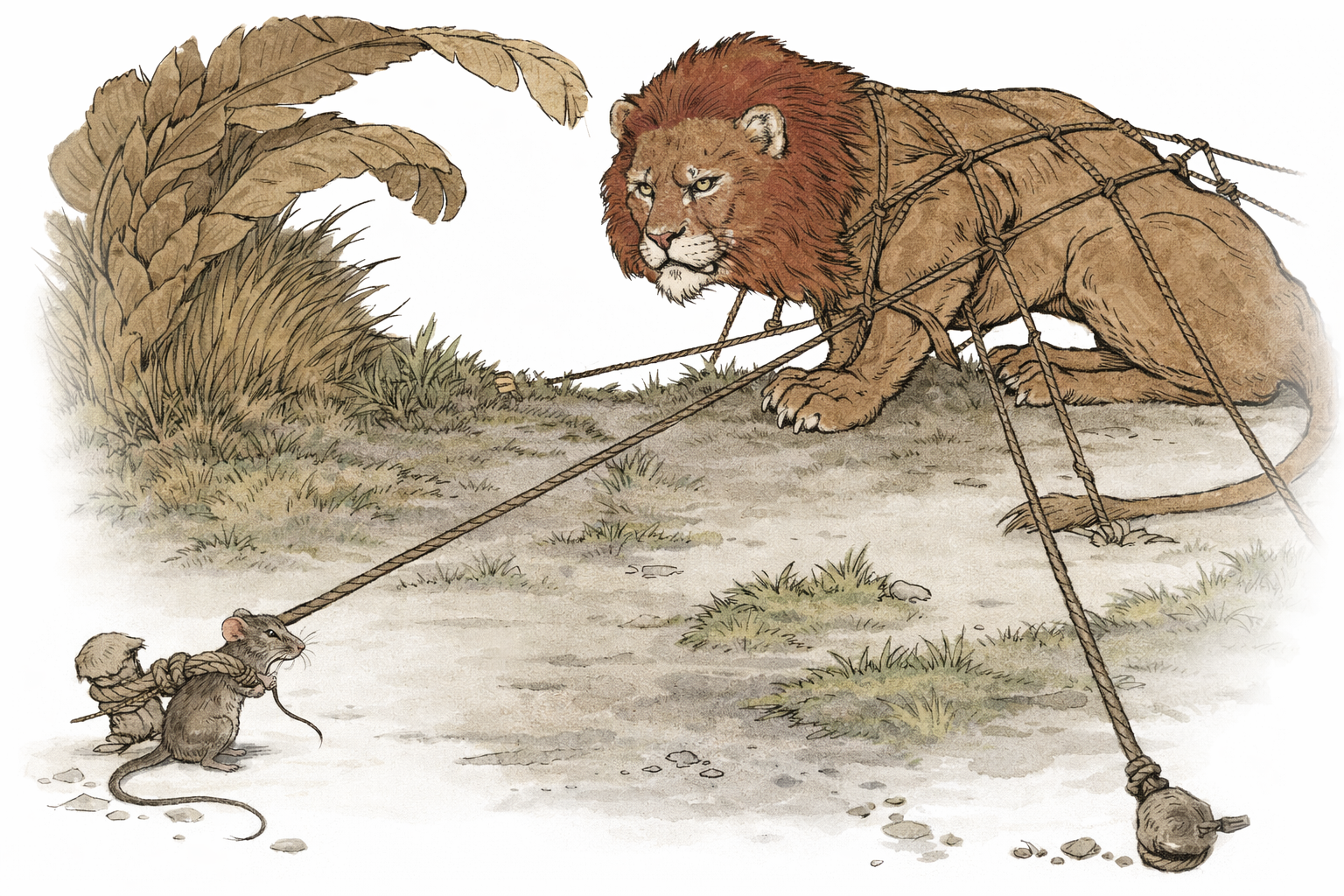
Onur na vin idh·reph velig i ewídher den, anodh den naden aranc, a rhong lain e·raw.
She ran to one [of] the great ropes that bound him, she gnawed it until it broke, and soon the lion [was] freed.
Running to one of the great ropes that bound him, she gnawed it until it parted, and soon the Lion was free.
1.12
“Iaedannel nin io ebennen i ‘restathon aen len,” ebent e·nigol.
“You laughed at me when I said that I would help you,” said the mouse.
"You laughed when I said I would repay you," said the Mouse.
1.13
“Si cheniol i nigol obul grestad raw.”
“Here you understand that [a] mouse can help [a] lion.”
"Now you see that even a Mouse can help a Lion."
Notes:
1 rongas, n. “haste” derived from ᴺS. !ronga- ᴺS. v. “to hasten” + S. #-as, suf. “abstract noun” [author: Rínor]
2 uvaur, adv. “someday” ⪤ ᴺQ. !umaurë, adv. “someday” [author: Parmandil]
3 rawed, n. “roar” derived from S. [N.] raw², v. “to roar” [author: Rínor]

e·Bíeg ah e·Vund

§
Sindarin
Back Translation
Original
1.1
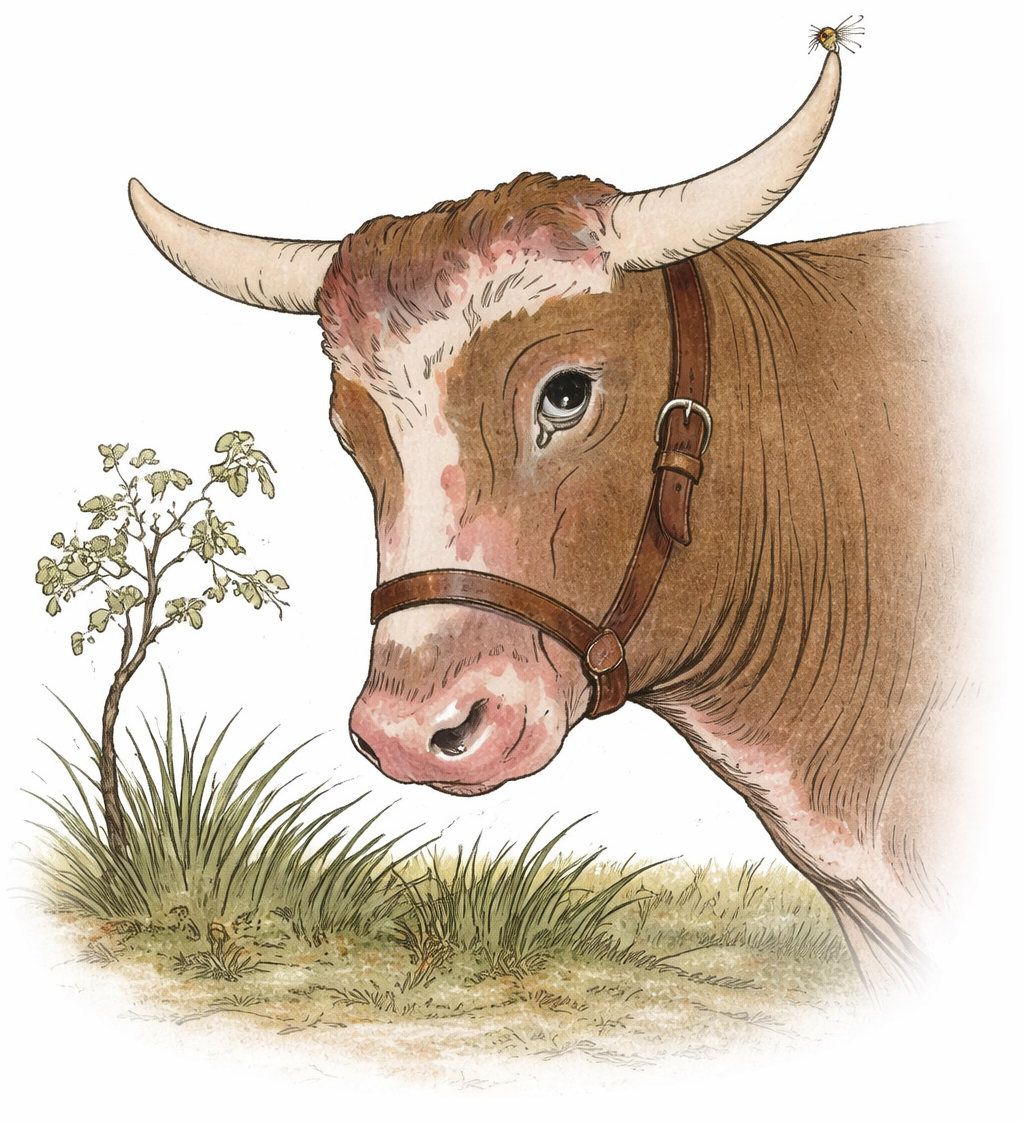
A Gnat flew over the meadow with much buzzing for so small a creature and settled on the tip of one of the horns of a Bull.
1.2
After he had rested a short time, he made ready to fly away.
1.3
But before he left he begged the Bull's pardon for having used his horn for a resting place.
1.4
"You must be very glad to have me go now," he said.
1.5
"It's all the same to me," replied the Bull.
1.6
"I did not even know you were there."
Notes:
1
2
3
4

Mablanthos

Notes:
1 Reviewed on Vinyë Lambengolmor by Ellanto on 11/27/25.
§
Sindarin
Back Translation
Original
1.1
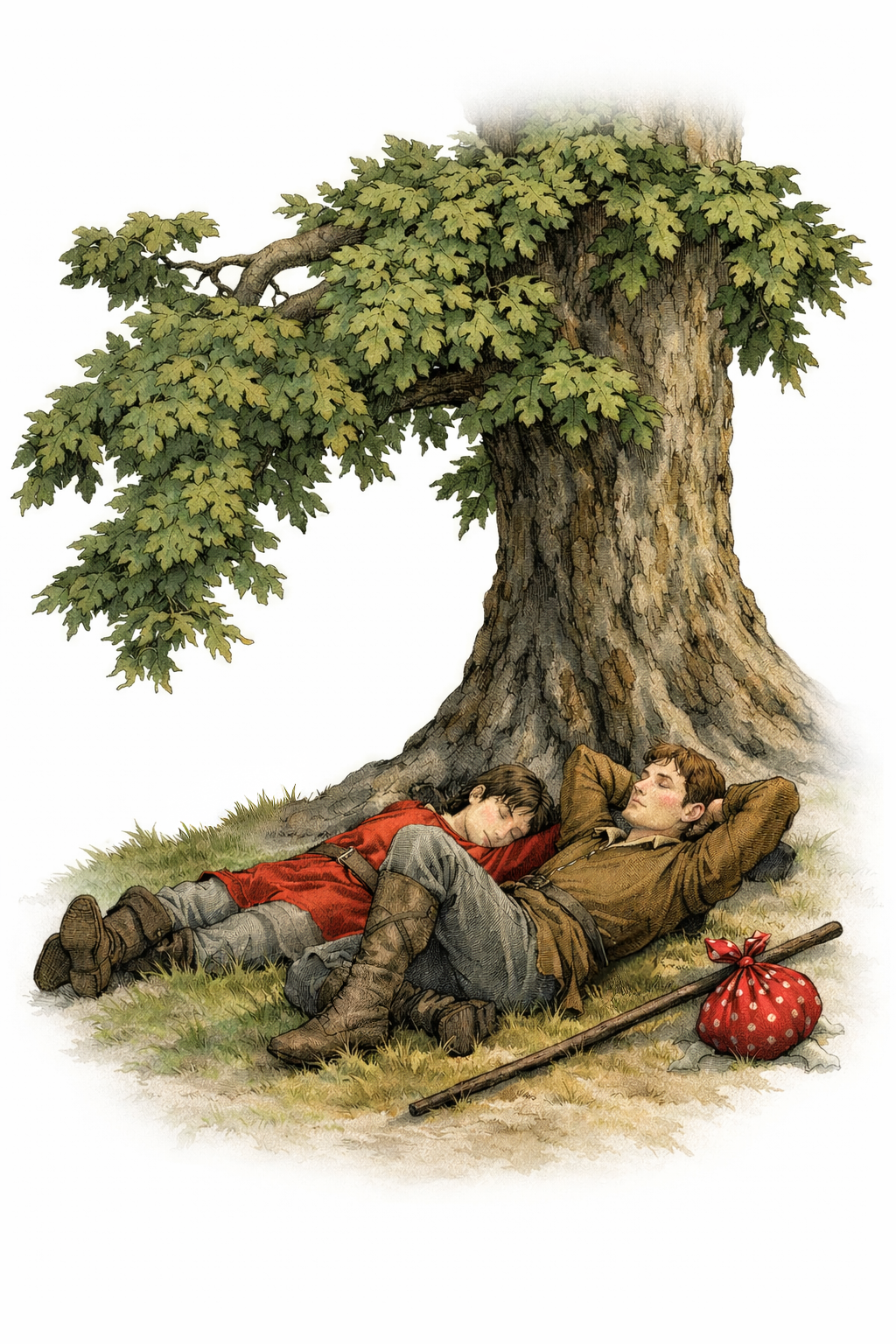
Glennyr1 dâd badrasser vi Anar nan e·nedhor a chestanner esgal na thaur land an hedhed.
Two travellers walked in [the] Sun of the mid-day and sought shade of [a] wide tree for resting.
Two Travelers, walking in the noonday sun, sought the shade of a widespreading tree to rest.
1.2
Lo gaedasser tirol i·lais elvain, heniasser i de Vablanthos.
While they laid looking (towards) the wonderful leaves, they understood that it [was a] Plane Tree.
As they lay looking up among the pleasant leaves, they saw that it was a Plane Tree.
1.3
Mablanthos de ú-gammui! ebent er ‘lennor1.
“[The] Plane Tree, it is not-suitable!” said one traveler.
"How useless is the Plane!" said one of them.
1.4
“Ú-iâf, ah air vuda tobad e·dalaf vo lais.”
“It does not bear fruit, and only it labours to cover the ground by (agent of) leaves.”
"It bears no fruit whatever, and only serves to litter the ground with leaves."
1.5
“Gwî ben-anned2! ebent glim ui Vablanthos.”
“Ungrateful creatures! said a voice from the Plane Tree.”
"Ungrateful creatures!" said a voice from the Plane Tree.
1.6
“Si hedhidh vin esgal ring nín, a phedidh i ni ú-gammui!
“Here you rest here in my cool shade, and you say that I am not-suitable!
"You lie here in my cooling shade, and yet you say I am useless!
1.7
Dîr ben-anned2, A Manwe, cevir in·eliad dín vil leng3 hen!”
Ungrateful men, O Manwë, receive their blessings in this manner!”
Thus ungratefully, O Jupiter, do men receive their blessings!"
Notes:
1 glannor, n. “traveler”
2 ben-anned, adj. “ungrateful (lit.) lacking thanks”
3 leng, n. “manner” ⪤ Q. lé¹ “way, method, manner”

e·Dhúcholl1 ah e·‘Laegabor2

§
Sindarin
Back Translation
Original
1.1
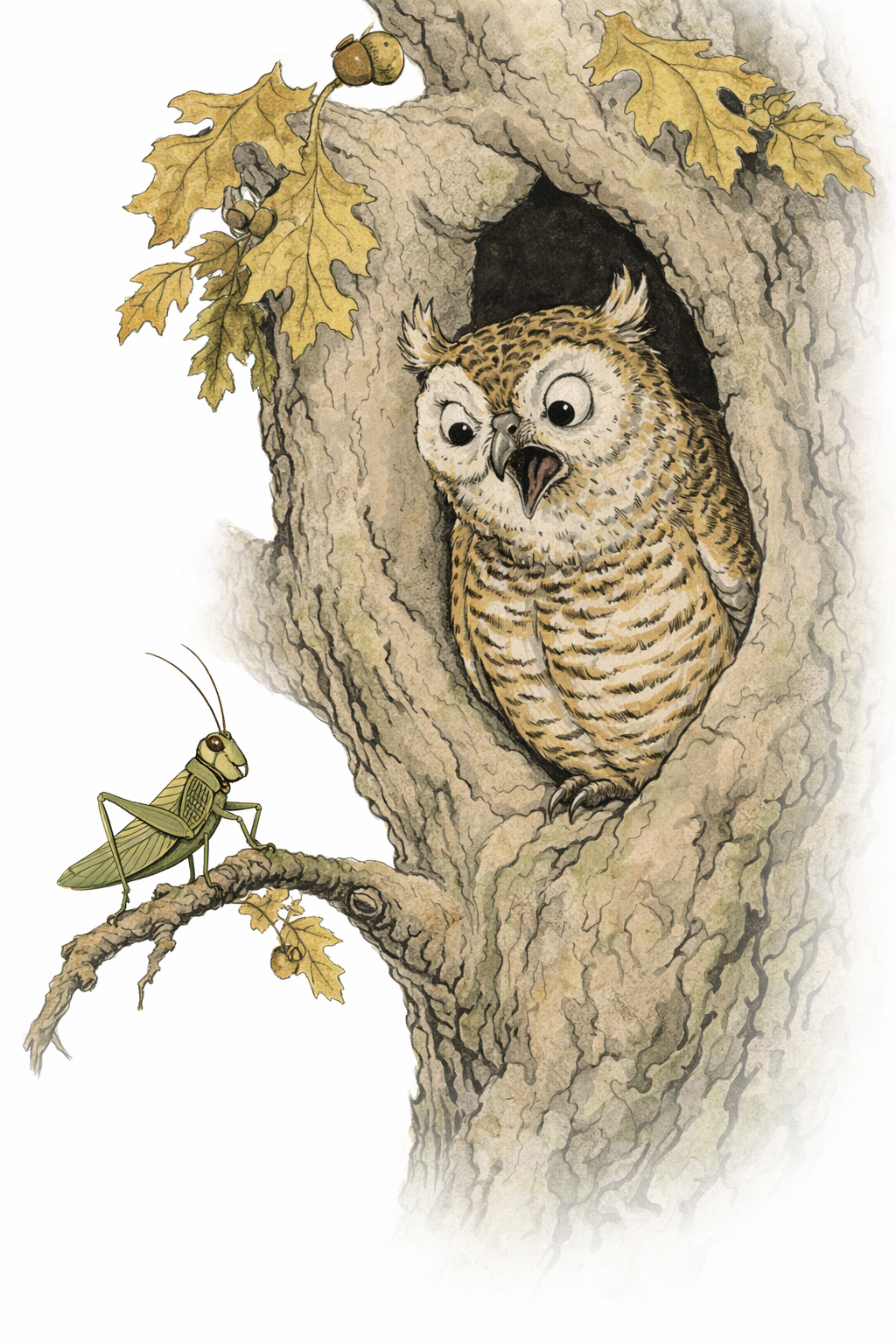
The Owl always takes her sleep during the day.
1.2
Then after sundown, when the rosy light fades from the sky and the shadows rise slowly through the wood, out she comes ruffling and blinking from the old hollow tree.
1.3
Now her weird "hoo-hoo-hoo-oo-oo" echoes through the quiet wood, and she begins her hunt for the bugs and beetles, frogs and mice she likes so well to eat.
1.4
Now there was a certain old Owl who had become very cross and hard to please as she grew older, especially if anything disturbed her daily slumbers.
1.5
One warm summer afternoon as she dozed away in her den in the old oak tree, a Grasshopper nearby began a joyous but very raspy song.
1.6
Out popped the old Owl's head from the opening in the tree that served her both for door and for window.
1.7
"Get away from here, sir," she said to the Grasshopper.
1.8
"Have you no manners? You should at least respect my age and leave me to sleep in quiet!"
1.9
But the Grasshopper answered saucily that he had as much right to his place in the sun as the Owl had to her place in the old oak.
1.10
Then he struck up a louder and still more rasping tune.
1.11
The wise old Owl knew quite well that it would do no good to argue with the Grasshopper, nor with anybody else for that matter.
1.12
Besides, her eyes were not sharp enough by day to permit her to punish the Grasshopper as he deserved.
1.13
So she laid aside all hard words and spoke very kindly to him.
1.14
"Well sir," she said, "if I must stay awake, I am going to settle right down to enjoy your singing.
1.15
Now that I think of it, I have a wonderful wine here, sent me from Olympus, of which I am told Apollo drinks before he sings to the high gods.
1.16
Please come up and taste this delicious drink with me. I know it will make you sing like Apollo himself."
1.17
Please come up and taste this delicious drink with me. I know it will make you sing like Apollo himself."
1.18
The foolish Grasshopper was taken in by the Owl's flattering words.
1.19
Up he jumped to the Owl's den, but as soon as he was near enough so the old Owl could see him clearly, she pounced upon him and ate him up.
Notes:
1
2
3
4

e·Nordh ah i·Lisg

Notes:
1 Reviewed on Vinyë Lambengolmor by Ellanto on 1/8/26.
§
Sindarin
Back Translation
Original
1.1
Nordh veleg ador ha cheleth ias1 Lisg fim óler.
[A] great oak stood along [a] brook where slender Reeds grew.
A Giant Oak stood near a brook in which grew some slender Reeds.
1.2
Io e·‘wae húdast, e·nordh veleg ador darlang a thalch, ah i·ñgelf doch dín alanner n’ ell.
When the wind blew, the great oak stood proud and upright, and its hundred branches stretched to [the] sky.
When the wind blew, the great Oak stood proudly upright with its hundred arms uplifted to the sky.
1.3
Ach i·lisg awórer eni ‘wae a lhinnanner lind dhem a nírol.
But the reeds yielded to the wind and sang [a] sad and sorrowful song.
But the Reeds bowed low in the wind and sang a sad and mournful song.
1.4
“Sevig gaeth an nornad,” ebent e·nordh.
“You have reason to complain,” said the oak.
"You have reason to complain," said the Oak.
1.5
“i·Whest robin i bresta balath e·nen ceiria gin loethad, lo im, nordh mbelaith, terin daer a thaug choe ‘waew vrui.”
“The littlest breeze that disturbs [the] surface of the water causes you to bend, while I, nordh mbelaith, terin daer a thaug choe ‘waew vrui.”
"The slightest breeze that ruffles the surface of the water makes you bow your heads, while I, the mighty Oak, stand upright and firm before the howling tempest."
1.6
“Av’ olo brestannen vo e·nast vín,” ebenner i·lisg.
“Don’t become troubled by (agent of) our being,” said the reeds.
"Do not worry about us," replied the Reeds.
1.7
“i·Ñgwae ú-geiriar charnas aphen.
“The winds do not cause harm to us.
"The winds do not harm us.
1.7a
Awóreb cho din, an ú-regib.
We yield before them, for we do not break.
We bow before them and so we do not break.
1.7b
Tauglog i·suil vo il e·vlaud a bellas gín.
You resisted the winds by (agent of) all your pride and strength.
You, in all your pride and strength, have so far resisted their blows.
1.7c
Ach dôl e·vethed.”
But the end [is] coming.”
But the end is coming."
1.8
Lo i·lisg ebenner, gwaew veleg ethul eph forod.
While the reeds spoke, [a] great storm came out of [the] north.
As the Reeds spoke a great hurricane rushed out of the north.
1.9
e·Nordh ador tarlang a dadhrant e·waew, lo i·lisg ‘warol loethasser chaug.
The oak stood proudly and opposed the storm, while the yielding reeds bent low.
The Oak stood proudly and fought against the storm, while the yielding Reeds bowed low.
1.10
e·‘Wae olast valch, ah e·‘aladh veleg dannast vregol, nerchennin i·sylch ui dalaf, a chaedast vig i·lisg nírol.
The wind became fierce, and the great tree fell suddenly, the roots were torn from the ground, and it lay among the sorrowful reeds.
The wind redoubled in fury, and all at once the great tree fell, torn up by the roots, and lay among the pitying Reeds.
Notes:

1 ias, pron. “where (relative)” ⪤ ᴹQ. yassë, adv. “there [remote, relative]”

2 Basing dôl e·vethed off of tôl acharn “vengeance comes / vengeance is coming”.


e·Gorch ah en·Olf

§
Sindarin
Back Translation
Original
1.1
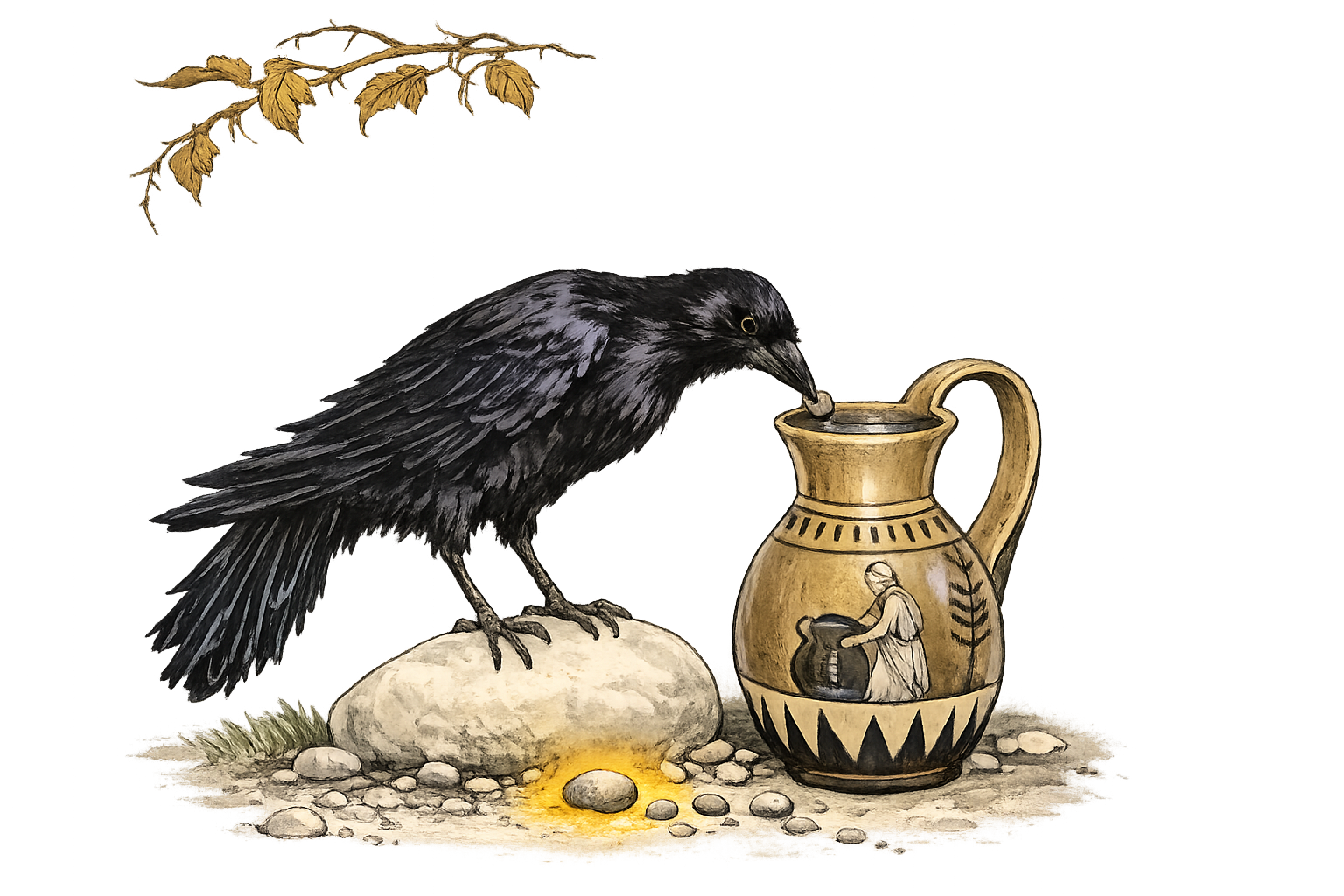
In a spell of dry weather, when the Birds could find very little to drink, a thirsty Crow found a pitcher with a little water in it.
1.2
But the pitcher was high and had a narrow neck, and no matter how he tried, the Crow could not reach the water.
1.3
The poor thing felt as if he must die of thirst.
1.4
Then an idea came to him.
1.5
Picking up some small pebbles, he dropped them into the pitcher one by one.
1.6
With each pebble the water rose a little higher until at last it was near enough so he could drink.
Notes:
1
2
3
4

i·Naeag Dâd

§
Sindarin
Back Translation
Original
1.1
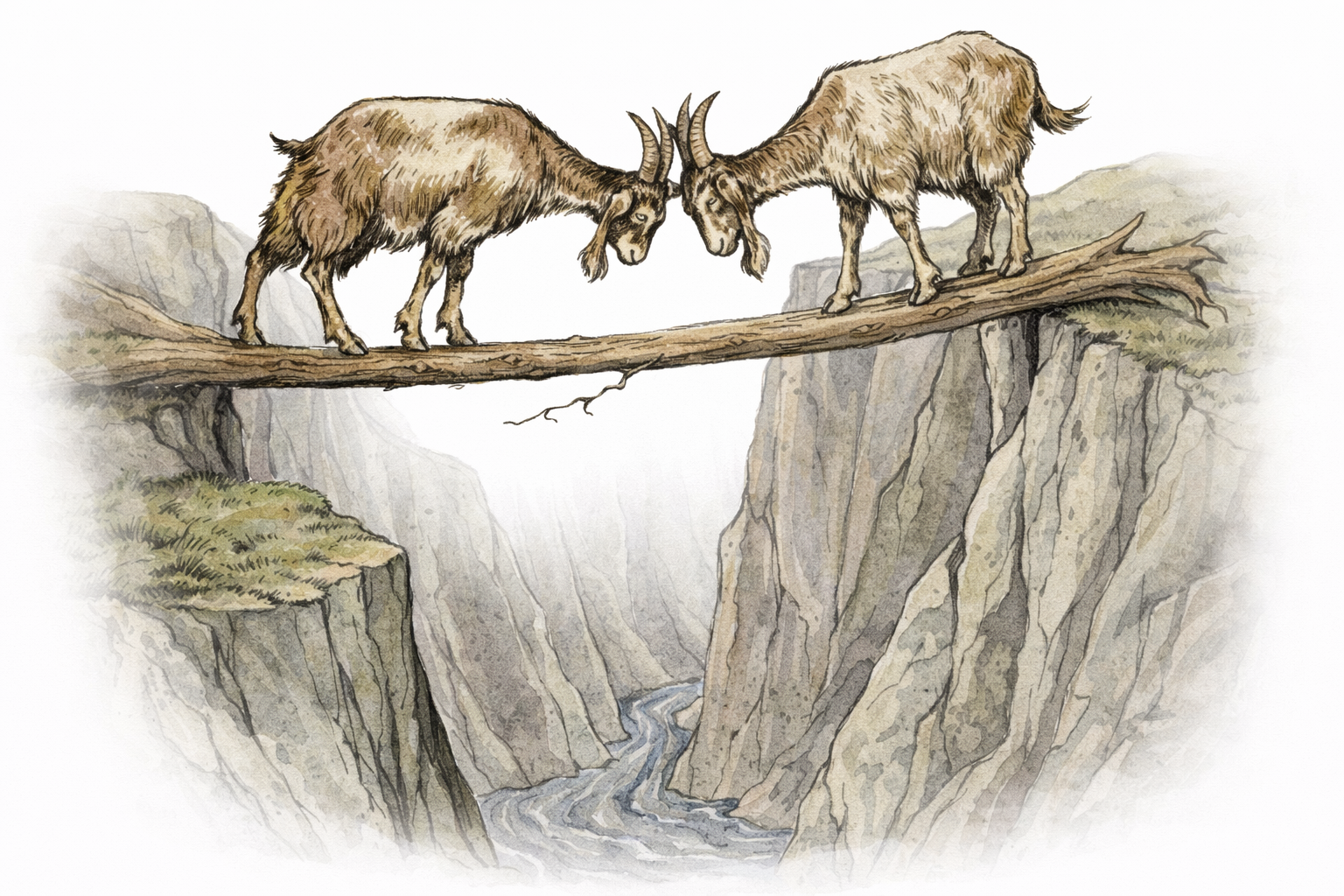
Two Goats, frisking gayly on the rocky steeps of a mountain valley, chanced to meet, one on each side of a deep chasm through which poured a mighty mountain torrent.
1.2
The trunk of a fallen tree formed the only means of crossing the chasm, and on this not even two squirrels could have passed each other in safety.
1.3
The narrow path would have made the bravest tremble.
1.4
Not so our Goats.
1.5
Their pride would not permit either to stand aside for the other.
1.6
One set her foot on the log.
1.7
The other did likewise.
1.8
In the middle they met horn to horn.
1.9
Neither would give way, and so they both fell, to be swept away by the roaring torrent below.
Notes:
1
2
3
4

en·Emel ah e·Dhraug

§
Sindarin
Back Translation
Original
1.1
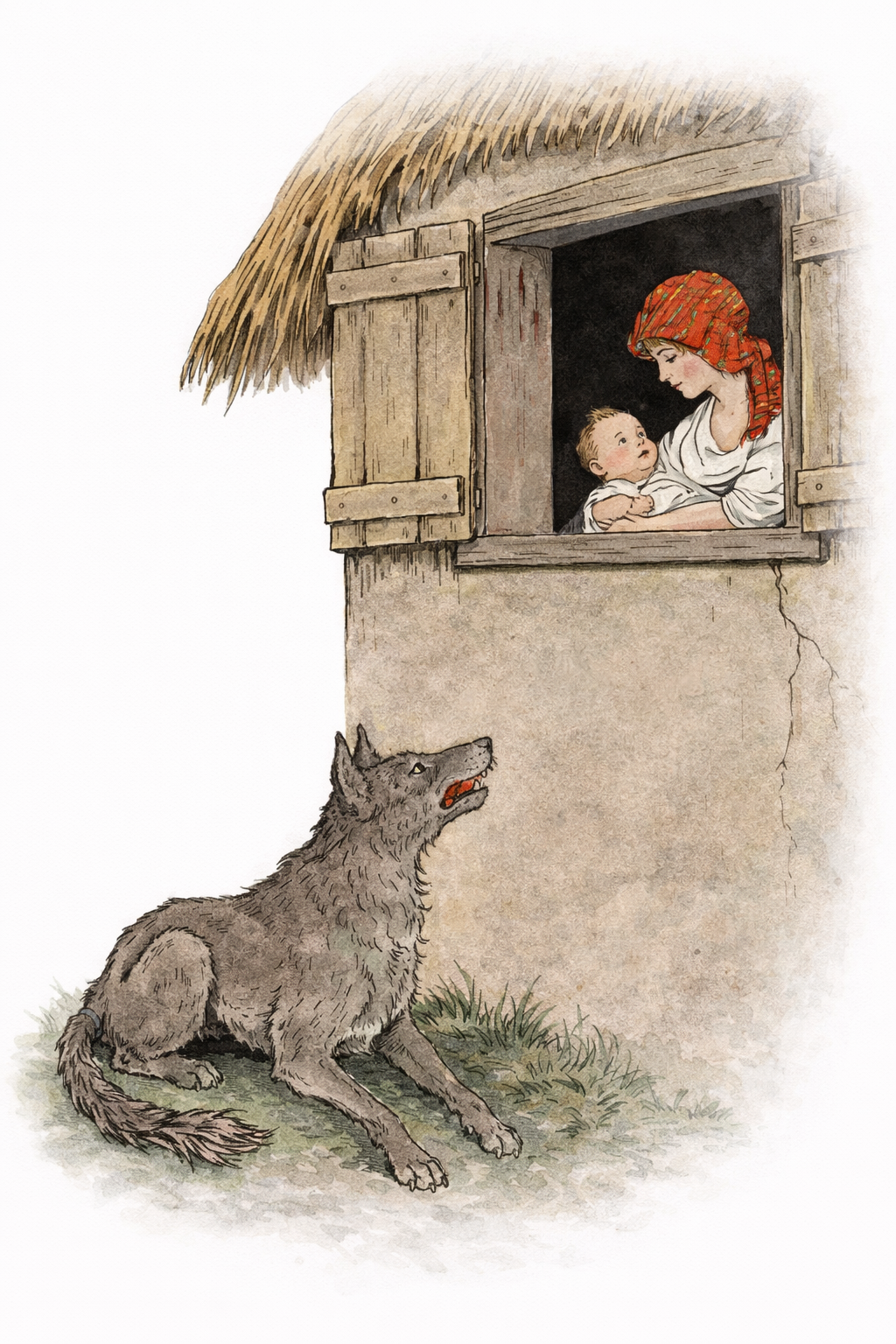
Er amor draug haeb ethlinc ha mbâr na daeg gobel, io lhassant chên nallol vim bâr.
One early day [a] hungry wolf crept beside [a] house at [the] boundary [of a] village, when he heard [a] crying child in the house.
Early one morning a hungry Wolf was prowling around a cottage at the edge of a village, when he heard a child crying in the house.
1.2
Mil luig han, lhassant ‘lim en·emel pedol:
In that moment, he heard [the] voice [of] the mother saying:
Then he heard the Mother's voice say:
1.3
“Sedho, hên, sedho! Posto e·nallad gín, egor annathon gin n’ e·dhraug!”
“Rest, child, rest! Stop your crying, or I will give you to the wolf!”
"Hush, child, hush! Stop your crying, or I will give you to the Wolf!"
1.4
e·Dhraug nî ‘aedannen vo ach ‘ellannen ed e·dunc an haved vâd elvain, caedast nu chenneth lediannen, a chorast i vil luig han cavatha aen chên.
The wolf was surprised by (agent of) but delighted out of the chance to have a wonderful meal, he lay under [an] opened window, and he expected that in the moment he would receive [a] child.
Surprised but delighted at the prospect of so delicious a meal, the Wolf settled down under an open window, expecting every moment to have the child handed out to him.
1.5
Ach valthannen e·‘winig, ah e·dhraug erith il aur ah agof allad.
But agitated [was] the little one, and the wolf remained in the same place all day and received nothing.
But though the little one continued to fret, the Wolf waited all day in vain.
1.6
To1, sui uial anglennast, lhassant ‘lim en·emel ad2 lo achodh s’ e·chenneth al linnad n’ e·‘winig dín a lhorthad den.
Then, as twilight approached, he heard [the] voice [of] the mother again while she sat beside the window to sing to her baby and to put it to sleep.
Then, toward nightfall, he heard the Mother's voice again as she sat down near the window to sing and rock her baby to sleep.
1.7
“No chídheb, hên!
“Be peaceful, child!
"There, child, there!
1.7a
e·Dhraug ú-ñgedatha gin.
The wolf will not get you.
The Wolf shall not get you.
1.7b
Û, û!
No, no!
No, no!
1.7c
Adar dîr ah adar ndagatha den bi dôl nef gin!”
Father is watching and father will slay him if he comes near you!”
Daddy is watching and Daddy will kill him if he should come near!"
1.8
Mil luig han en·adar odul vi chent e·mbâr, ah e·dhraug othrast agor i·chui vo nored vaed.
In that moment, the father came into sight [of] the home, and the wolf narrowly escaped the dogs by (agent of) running skillfully.
Just then the Father came within sight of the home, and the Wolf was barely able to save himself from the Dogs by a clever bit of running.
Notes:
1 to, adv. “so, then” ⪤ Q. , adv. “then, [ᴹQ.] at that time [past]” [author: Elaran]
2 ad adv. "again" ⪤ ᴹQ. ata adv. “again, *(lit.) a second time”

e·Limron1 ah e·Lim bîn

§
Sindarin
Back Translation
Original
1.1
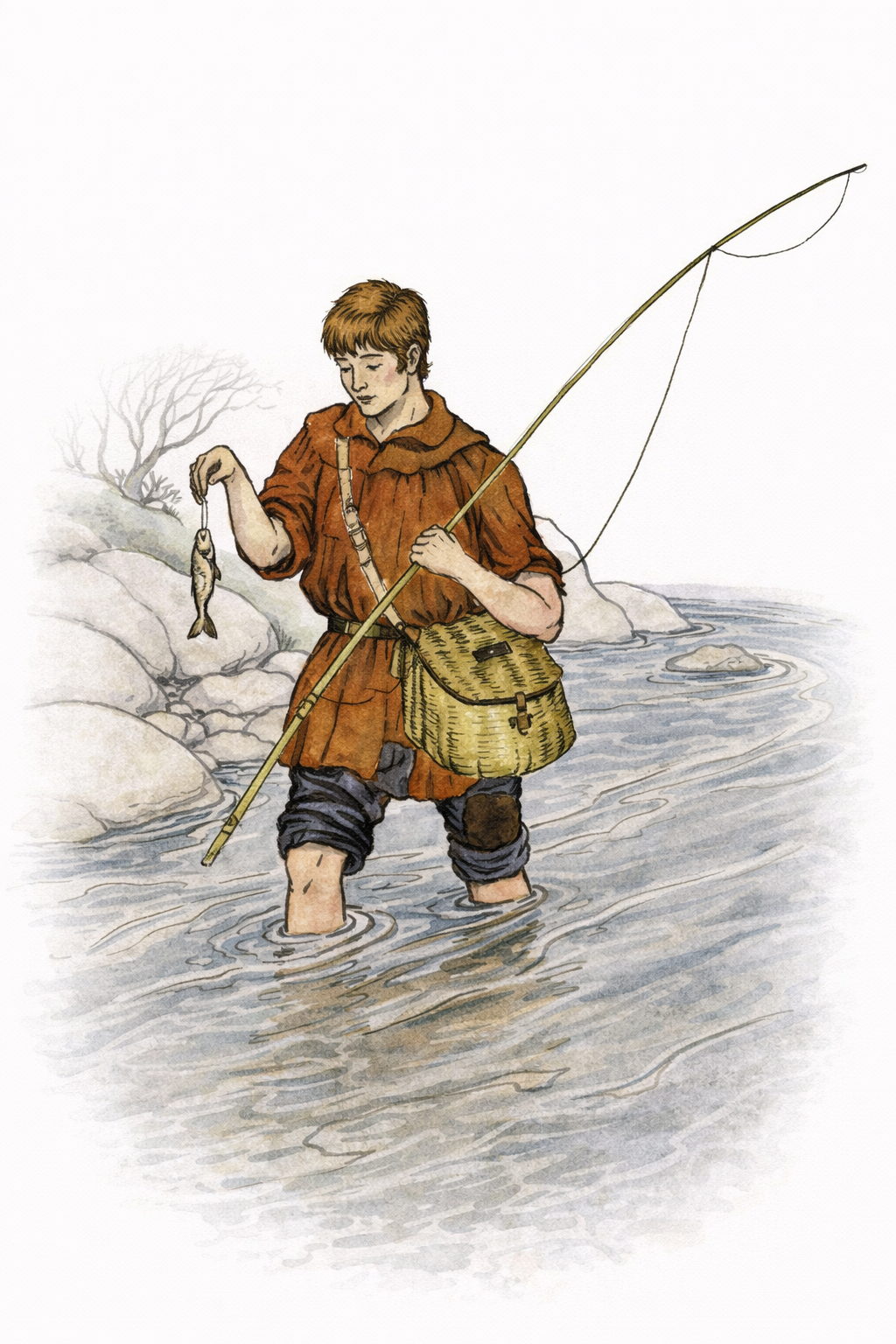
Limron1 ú-vaeligui2 i vronant voe lim raedant aw ú-eliad er aur ah raedant air limmeg dae bîn.
A not-wealthy fisherman who survived by the fish he caught had no blessing one day and caught only [a] very small fry.
A poor Fisherman, who lived on the fish he caught, had bad luck one day and caught nothing but a very small fry.
1.2
e·Limron¹ enidh panned den viñ gwircholch3 dín io e·lim bîn ebent:
The Fisherman intended to put it in his basket when the little fish said:
The Fisherman was about to put it in his basket when the little Fish said:
1.3
Listo dhavo nin cuiad Limdir Hîr!
“Please allow me to live, Master Fisherman!
"Please spare me, Mr. Fisherman!
1.3a
Ni bîn a ni ú-vall farn allen coled nin mbâr.
I am small, and I am not worthy enough for you to carry me home.
I am so small it is not worth while to carry me home.
1.3b
Io ni ammorg, olathon vael ammaer allen.”
When I [am] bigger, I will become [a] better meal for you.”
When I will be bigger, I shall make you a much better meal."
1.4
Ach e·limron bannant vregol e·lim viñ gwircholch3 dín.
But the fisherman suddenly put the fish in his basket.
But the Fisherman quickly put the fish into his basket.
1.5
“Ni fovren redhiad gin,” ebent.
“I am foolish to return you,” he said.
"How foolish I should be," he said, "to throw you back.
1.7a
e·Dhraug ú-ñgedatha gin.
The wolf will not get you.
The Wolf shall not get you.
1.7b
Î bi gi bîn, gi ammaer athar saved allad.
Even if you are small, you are better beyond having nothing.
However small you may be, you are better than nothing at all."
Notes:
1 limron, n. “so, then” ⪤ ᴺQ. !lingwimo, n. “fisherman” [author: Rínor]
2 Note from Ellanto from a previous translation: I think maeligui adj. "wealthy, characterised by wealth" ⪤ ᴺS. !maeligeb
3 gwircholch n. "basket, (lit.) woven-box" ⪤ ᴺQ. !vircolca n. “basket, (lit.) woven-box” [Elaran]